Our Practice Framework
Cultivating Excellence Through Integrated Professional Practice
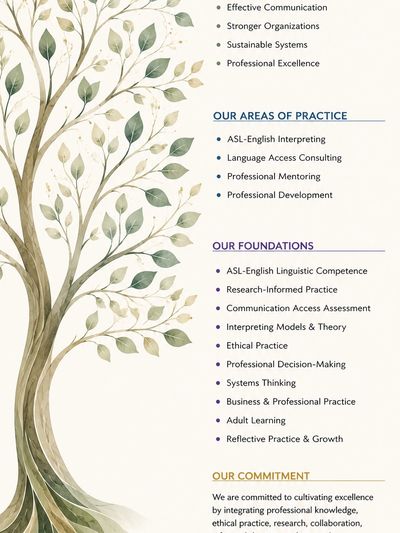
Professional excellence is cultivated through the integration of knowledge, experience, ethical practice, research, reflection, and continuous learning. Like the roots of a healthy tree, the foundations of professional practice often remain unseen, yet they provide the strength, stability, and nourishment that support meaningful communication and long-term growth.
Our Belief
We believe professional excellence is not developed through a single competency. It is cultivated through the integration of multiple disciplines that continually inform and strengthen one another.
Interpreting, consulting, mentoring, teaching, assessment, and professional development are not separate activities. Each area of practice contributes to and is strengthened by the others.
Through this integrated approach, we strive to strengthen communication access, support meaningful participation, and build sustainable communication systems.
Our Framework
Our Practice Framework reflects the belief that professional excellence develops through the continual interaction of knowledge, reflection, collaboration, and experience.
Rather than viewing professional competencies as isolated skills, we recognize that each discipline strengthens and informs the others. Ethical practice influences decision-making. Research strengthens professional judgment. Assessment informs planning. Mentoring deepens professional knowledge. Systems thinking strengthens organizational practice.
Together, these disciplines form an integrated framework that guides every service we provide.
The Foundations
Professional excellence is strengthened through the integration of multiple professional disciplines.
ASL-English Linguistic Competence
A deep understanding of ASL and English provides the foundation for meaningful communication. Professional practice requires more than bilingual fluency; it requires knowledge of language structure, discourse, pragmatics, sociolinguistics, and cultural context.
Research-Informed Practice
Research strengthens professional judgment by integrating current knowledge from interpreting studies, linguistics, language acquisition, discourse analysis, Deaf education, cognitive science, adult learning, and communication access.
Communication Access Assessment
Effective communication begins with understanding the individual and the communication environment. Assessment considers language proficiency, communication goals, participant needs, environmental factors, and system variables that influence communication access.
Interpreting Models and Theory
Professional models provide valuable perspectives for analyzing communication, understanding interpreting processes, and supporting informed professional practice.
Ethical Practice
Professional standards provide an essential foundation for integrity, accountability, confidentiality, impartiality, and professional responsibility across all areas of practice.
Professional Decision-Making
Professional judgment requires more than applying rules. Effective decision-making integrates ethics, research, context, communication goals, and the unique characteristics of each situation.
Systems Thinking
Communication occurs within larger educational, organizational, family, healthcare, vocational, and community systems. Understanding these relationships supports more effective planning, collaboration, and long-term improvement.
Business and Professional Practice
Professional excellence includes preparation, reliability, communication, documentation, collaboration, continuing education, accountability, and responsible business practices that strengthen trust and service quality.
Reflective Practice and Continuous Growth
Learning is an ongoing professional responsibility. Reflection, mentoring, assessment, feedback, and continuing education continually strengthen professional competence and communication access.
Areas of Practice
The same integrated framework guides every service we provide.
ASL-English Interpreting
Supporting meaningful communication through informed, research-based, and ethically grounded interpreting practice.
Language Access Consulting
Helping organizations strengthen communication access through assessment, planning, collaboration, and systems improvement.
Professional Mentoring
Supporting interpreter growth through reflective practice, competency-based assessment, coaching, and professional development.
Professional Development
Designing presentations, workshops, and educational opportunities that strengthen professional knowledge and communication access.
Explore Our Framework
Each component of our practice framework is explored in greater depth throughout this website.
Discover the disciplines, research, and professional knowledge that form the foundation of our philosophy.
Integrated Professional Practice
Learn how knowledge from multiple disciplines is intentionally integrated to strengthen communication access, professional reasoning, and organizational systems.
Explore our visual practice model and discover how our integrated approach supports professional growth, meaningful participation, and communication capacity.
Our Commitment
At My Interpreting Service, we believe communication access is not measured simply by the presence of an interpreter. It is measured by the ability of Deaf individuals to participate meaningfully, receive information accurately, and engage fully in the environments where they live, learn, work, and contribute.
Our commitment is to strengthen communication access by integrating professional knowledge, ethical practice, research, collaboration, informed decision-making, and continuous growth into every service we provide. Through this integrated approach, we strive to support effective communication that is thoughtful, responsive, and centered on the unique needs of the individuals and organizations we serve.